


Sustainability is no longer just a trend. It is now essential for every major brand, especially in fast-food restaurants. If you have ever unwrapped a Wendy’s burger or grabbed fries on the go, you have already experienced a carefully designed system of packaging that most people never notice.
Sustainable food packaging goes beyond recycling or compostable materials. It is about creating a better experience for customers, improving efficiency in operations, and reaching important environmental goals while keeping costs manageable.
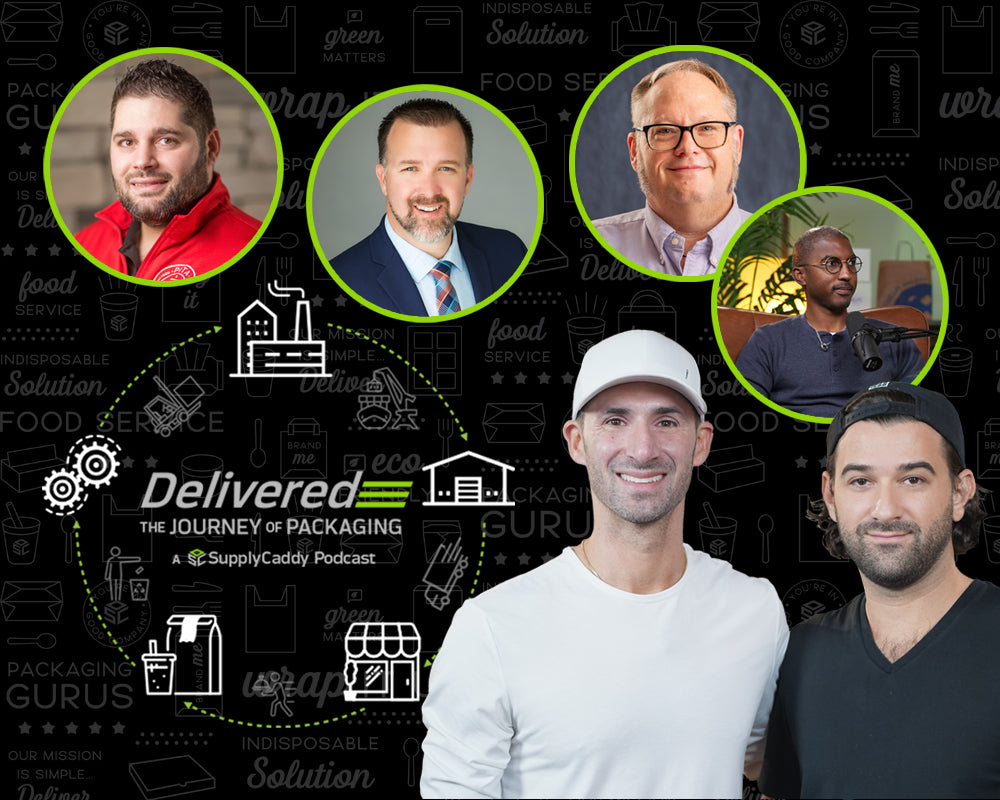
In the latest episode of the Delivered Podcast, Bradley Saveth, Co-Founder, President, and COO, and Zachary Stein, Co-Founder and CEO of SupplyCaddy, spoke with Carlos Londono. As Global Manager of Packaging, Innovation and Sustainability at Wendy’s, Carlos shares his perspective on the challenges and decisions involved in growing a quick-service restaurant brand today.
From innovative packaging to regulatory demands and changing customer expectations, this conversation goes beyond the surface. If you want to understand what truly sustainable food packaging looks like at Wendy’s and how a leading brand approaches these challenges, this episode offers valuable insights.
Why Sustainable Food Packaging Conversations Matter Right Now
Sustainability in food packaging has moved from optional to urgent. Carlos Londono emphasizes that, “Probably my biggest concern or challenge…is sustainability. Because if you ask me, most of the time, sustainability options in terms of packaging are more expensive than current ones.”
For brands like Wendy’s, every packaging decision impacts thousands of locations, millions of meals, and billions of consumer interactions. The industry faces real challenges: recyclable options may not be supported by local infrastructure, compostable packaging often never reaches a composting facility, and every new regulatory requirement, like EPR (Extended Producer Responsibility), introduces costs and complexity.
Carlos notes, “We don’t have the places where they can, you know, deal with compostable or even PCR. I mean, it is easy to talk about different solutions, but the reality is, we are not ready. I’m talking about the United States of America.”
You see, sustainability is not just about swapping one material for another. It’s a balancing act between environmental responsibility, cost management, and the consumer experience. When done right, sustainable food packaging doesn’t just protect the environment, it enhances the brand and the meal experience.
Carlos Londono’s Background and Perspective on Scaling QSR Brands
Carlos brings a rare combination of industrial design expertise and packaging experience. He explains, “From industrial designer to 30 years in packaging…my first contact with packaging actually was during my internship in one of the biggest CSD factories in Colombia. I was doing glass bottles in Bogota.”
After co-founding a packaging company and spending nearly two decades with a global packaging leader, Carlos transitioned to QSRs, first Popeyes and now Wendy’s. His journey is unique because he has seen packaging from every angle: as a supplier, a designer, and a brand.
He reflects, “When I joined Popeyes, I started working with bags and boxes. And two years later, they called me and said, “look, we need someone like you”…now at Wendy’s.”
This perspective gives him a critical edge. He understands material science, supply chain limitations, cost constraints, and consumer behavior. This expertise allows him to navigate complex decisions in sustainable food packaging without over-engineering or losing focus on the end-user.
Why Simple Innovation Is the Key to Sustainable Food Packaging
When it comes to packaging, Carlos believes in simplicity. He says, “Industrial design or packaging needs to be simple. If you do something that is too complex, you put a limit between the consumer and your product. Nobody’s going to use it.”
One of his standout innovations at Wendy’s involves transforming a bag into a functional sandwich holder. The idea seems simple, yet it took five years to develop. Carlos explains, “That bag will transform into kind of like a sandwich holder. It’s just a simple concept…we kept the same materials, same dimensions, but it changed the moment of consumption.”
Simple design isn’t just about aesthetics. It’s about functionality, sustainability, and operational efficiency. By removing unnecessary layers or combining multiple packaging items into a single item, Wendy’s reduces material waste, lowers costs, and enhances the customer experience, all without compromising food quality.
Putting Consumer Experience First in Wendy’s Food Packaging Decisions
For Carlos, the consumer always comes first. “Always. Because you’re designing something for whom? The consumer, right?” he says. Every design decision starts with the customer. Is it easy to open? Does it keep the food fresh? Does it feel natural in the hand?
Even small changes, like replacing foil wrappers with a paper alternative, require significant testing. “It’s just a wrapper, but there’s so much technicality,” Carlos explains. “How can you keep the heat retention on the burger? How can you release the steam inside? There’s a lot of science behind it.”
This focus on consumer experience ensures that sustainability doesn’t compromise enjoyment. Whether it’s a wrapper, a clamshell, or a cup, every packaging item is evaluated for ease of use, functionality, and impact on the food itself.
How Delivery Platforms and Apps Reshaped QSR Packaging and Sustainability
The pandemic accelerated a trend that was already changing the game: delivery and digital ordering. Carlos emphasizes that delivery transformed consumer behavior almost overnight. “After COVID, the whole consumer behavior changed, I mean, just like that…people couldn’t go to a restaurant, so they started asking for products by mail. QSR had to adjust, and packaging was not ready.”
Delivery adds unique pressures on sustainable packaging. It must maintain temperature, prevent spills, and survive transit while still being environmentally responsible. Wendy’s has been innovating to meet these challenges without overcomplicating the design.
Apps and online ordering have also changed expectations. Consumers interact with packaging more than ever, opening items at home or on the go. Carlos notes that packaging is the “first real contact the consumer is gonna have with a product,” and that contact must feel intuitive, clean, and human.
EPR Regulations and Why They Are Becoming a Major Challenge for QSR Brands
Extended Producer Responsibility (EPR) laws are emerging across the U.S., requiring companies to take responsibility for the environmental impact of their packaging. Carlos warns that this is one of the industry’s biggest challenges: “Every single day, you’re getting more and more EPRs, more states asking for EPRs.”
Compliance is complex because regulations vary widely by state and even by county. For example, a paper cup solution that works in New Jersey may not meet California standards. “We need a solution that is good in California, but also in New Jersey, and also in Florida,” Carlos says.
This regulatory environment forces QSRs like Wendy’s to innovate faster and partner with packaging experts who understand both materials science and supply chain logistics.
Why the Right Food Packaging Partners Matter More at Scale
Scaling a brand is never easy. Wendy’s serves millions of meals every year, which means millions of wrappers, cups, and containers. Even small inefficiencies or unsustainable materials can add up to huge waste and costs.
That is why having the right packaging partner is critical. At SupplyCaddy, we delivered over 150 million packaging units in 2025 with a 99.1 percent order accuracy rate. We work with top brands like Cinnabon, Burger King, Delta, Dave’s Hot Chicken, Popeyes, Bodega, and Tijuana Flats to make sure sustainable food packaging works consistently, in every restaurant, every day.
If your brand is ready to scale without compromising sustainability, reliability, or cost, SupplyCaddy can make it happen. Contact us today to see how we can streamline your packaging and support your growth at scale.